India’s New Wage Code 2025: What It Really Means for Global Companies Hiring Through EOR
India just rewrote the rulebook on how salaries are structured, how quickly employees must be paid on exit, and how much companies owe in provident fund and gratuity. If you’re an international company employing people in India — whether directly or through an Employer of Record (EOR) — this isn’t a regulatory footnote. It’s a change that touches every offer letter, every payroll run, and every exit you process.
This article breaks down what actually changed, what it means in practice, and the specific challenges we’re seeing international companies run into as they try to stay compliant.
1. What Is the New Wage Code, in Plain Terms
Effective 21 November 2025, India consolidated 29 older labour laws into four unified Labour Codes:
- Code on Wages, 2019
- Code on Social Security, 2020
- Industrial Relations Code, 2020
- Occupational Safety, Health and Working Conditions Code, 2020
Of these, the Code on Wages is the one reshaping payroll most immediately, because it introduces a single, uniform definition of “wages” that now applies across all four codes — including PF, gratuity, bonus, and leave encashment calculations.
Central rules were notified on 8 May 2026, but state-level rules are still rolling out at different speeds, which means the practical compliance timeline can vary depending on where your employees are based.
2. The 50% Wage Rule — The Change Everyone’s Talking About
This is the core structural shift, and the one most likely to catch international employers off guard.
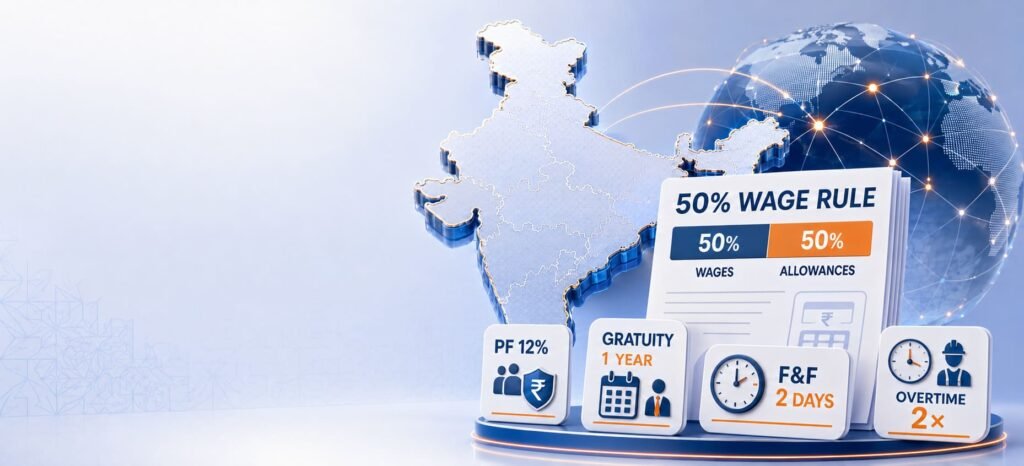
The rule: Basic pay + Dearness Allowance (DA) + retaining allowance must together make up at least 50% of an employee’s total CTC (Cost to Company). Everything else — HRA, conveyance, special allowances, telephone allowance, meal vouchers, and similar components — must fit within the remaining 50%. If allowances exceed that cap, the excess is legally treated as “wages” and pulled back into the calculation base for PF and gratuity.
Why this matters: For decades, it was common — and completely legal — for Indian employers to structure salaries with basic pay at just 30–40% of CTC, loading the rest into allowances specifically to keep PF and gratuity contributions low. That workaround is now closed.
What actually changes when basic pay goes up:
- Provident Fund (PF): The contribution rate stays at 12% employee + 12% employer, but the base it’s calculated on expands — so both sides pay more in absolute terms.
- Gratuity liability: Because gratuity is calculated on basic pay, raising basic pay from say 30–35% to 50% of CTC can increase gratuity liability by an estimated 25–50%, according to industry actuarial assessments.
- Take-home pay: Employees may see monthly take-home drop by roughly 2–5%, even though their long-term retirement benefits improve.
- Accounting treatment: Under Ind AS 19, any resulting increase in gratuity obligations must be recognised immediately in the profit & loss statement — companies can’t defer or amortise it. For businesses with large India-based teams, this can mean a real one-time hit to reported earnings.
3. Other Changes That Are Just as Important (and Easy to Miss)
The 50% rule gets most of the attention, but several other changes directly affect how international employers manage India-based staff:
- Full & Final (F&F) settlement is now a 2-working-day deadline. Under Section 17(2) of the Code on Wages, all wages owed on resignation, termination, retrenchment, or retirement must be paid within two working days — down from the old industry norm of 30–90 days. Missing this deadline is a compliance violation, with penalties of up to ₹50,000 for a first offence.
- Fixed-term and contract employees now qualify for gratuity after just 1 year, instead of the previous 5-year threshold. This is a major shift for companies that rely heavily on fixed-term hires.
- Overtime must be paid at 2x the normal wage rate, standardised across sectors.
- Equal pay for equal work provisions have been broadened, and now explicitly include transgender employees.
- A national floor wage now sets a baseline that no state can undercut, though individual states can still set higher minimums.
4. A Real-World Scenario
To make this concrete: imagine an international SaaS company employing 40 people in India through an EOR, with a typical pre-2025 salary structure — basic pay at roughly 35% of CTC, the rest loaded into HRA and special allowances.
Under the new rule, that company’s EOR partner has to:
- Re-benchmark all 40 CTC structures so basic + DA reaches at least 50%
- Recalculate PF contributions for every employee — a direct increase in monthly employer cost
- Revalue gratuity liability on the balance sheet, potentially triggering a one-time P&L adjustment
- Rebuild payroll workflows so any exit — voluntary or otherwise — can be fully settled within 2 working days, not the 30-45 days the finance team may have budgeted around
- Track which of those 40 employees are on fixed-term contracts, since several may now be newly eligible for gratuity after just 12 months
Multiply that across multiple entities, multiple states with different rule timelines, and ongoing hiring — and it becomes clear why “just update the payroll template” isn’t a realistic response.
5. Practical Challenges for International Companies Using EOR in India
We work with global companies expanding into India every day, and the same set of challenges keeps surfacing:
- Legacy CTC templates are now non-compliant by default. Most offer templates built before late 2025 assume 30–40% basic pay. Every one of them needs to be re-modelled — not just for new hires, but for existing employees too.
- Budgets built on old assumptions no longer hold. Finance teams that forecasted India headcount costs based on pre-2025 PF and gratuity math are now working with stale numbers, sometimes by a significant margin.
- State-by-state variation breaks the “one template fits all India” approach. With states finalising rules at different paces, a single national CTC structure may be compliant in one state and not fully aligned in another.
- The 2-day settlement rule requires real operational change, not just policy language. Batch-processing exits alongside the next payroll cycle — a common practice — is no longer workable. Settlement calculations need to happen in near real time.
- Fixed-term workforce tracking becomes a compliance requirement, not a nice-to-have. Companies with rolling contract hires now need accurate service-tenure tracking to know exactly who has crossed the 1-year gratuity threshold.
- Spreadsheet-based payroll doesn’t scale under this complexity. Manually recalculating PF, gratuity, bonus, and leave encashment for every employee against multiple state rules is where errors creep in — and one formula mistake can cascade across an entire payroll run.
- Communicating the change to a global workforce is its own challenge. Employees may notice lower take-home pay before HR has had the chance to explain the long-term retirement benefit trade-off, which can create avoidable friction if not managed proactively.
6. Common Mistakes We’re Seeing Companies Make
- Assuming the change is “just an HR update” rather than a finance, legal, and payroll issue simultaneously
- Waiting for state rules to fully stabilise before restructuring CTCs — which delays compliance rather than avoiding it
- Restructuring basic pay without also modelling the downstream gratuity and PF cost increase
- Not distinguishing between wage components covered by the 2-day F&F rule and statutory payments like gratuity, which can follow a different timeline
- Failing to flag fixed-term employees who have newly crossed the 1-year gratuity mark
How ExpanServe Helps You Stay Compliant — Without the Guesswork
This is exactly the kind of regulatory shift where having the right EOR partner stops being a convenience and starts being a genuine risk control.
At ExpanServe, we’re actively tracking Central and state-level rule notifications as they’re released, and we’re proactively restructuring every EOR employee’s CTC to meet the 50% wage threshold — without disrupting your budget planning or your employees’ experience. We handle the PF and gratuity recalculations, the 2-day F&F settlement process, and the fixed-term gratuity tracking end-to-end, so your team doesn’t have to become India labour law experts overnight.
One point of contact. Full transparency. A workforce strategy that stays compliant as the rules continue to evolve.
If you’re managing a team in India — or planning to — let’s talk about what a compliance-ready payroll structure looks like for your business.